
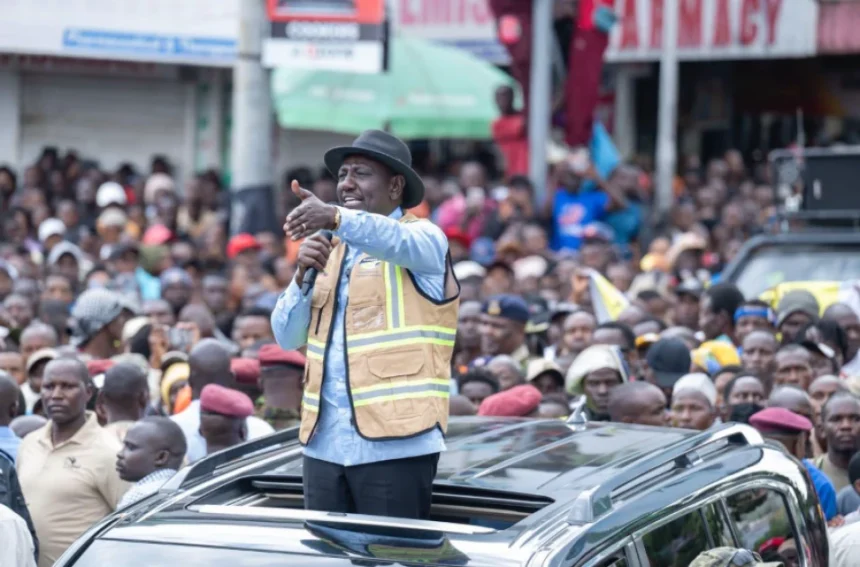
A picture of a sleek, eight-lane highway with a confused emoji slapped on it. A mock-up of a historical exam question: “Explain why President Ruto vowed to dual the Nairobi-Thika Road.” A satirical video of a government official announcing the discovery of a “new, secret single-lane Thika Road.” The Kenyan digital sphere erupted in a wave of creative, witty, and deeply sarcastic content following President William Ruto’s recent pledge to dual the Nairobi-Thika Road. The public reaction wasn’t just confusion; it was a full-blown cultural response, a collective roast powered by a simple, indisputable fact: the road is already a world-class superhighway.
But while the laughter was justified, it also risked obscuring the more serious questions beneath the surface. In politics, as in communication, few things are truly accidental. A statement that appears so blatantly disconnected from reality on its face often serves a different, calculated purpose. To understand the Thika Road pledge, we must look beyond the tarmac and into the realms of political messaging, regional economics, and public trust. This wasn’t a gaffe about a road; it was a Rorschach test for Kenya’s current political and economic mood.
Theory 1: The “Legacy Rebrand” and the Ghost of Uhuru Kenyatta
The most compelling political reading of the pledge is the “Legacy Rebrand” theory. The Nairobi-Thika Superhighway is not just any road; it is the crowning infrastructure achievement of former President Uhuru Kenyatta’s first term, inaugurated with great fanfare in 2012. For the current administration, which has positioned itself as a break from the past, there exists a delicate dance: how to acknowledge essential national assets built by predecessors while claiming a new, transformative direction.
Promising to “dual” an already-dualled road could be interpreted as a clumsy attempt to re-claim and re-frame this piece of national infrastructure. By announcing a new project for it, the administration symbolically takes ownership of its future, attempting to shift public association from the builder (Kenyatta) to the improver (Ruto). It’s a political manoeuvre to overlay a new legacy onto an old one, suggesting that the previous work was incomplete and now requires a “Chapter Two.” The risk, as seen, is that if the public memory is longer than the political strategy, the move backfires spectacularly, making the new administration look out of touch rather than visionary.
Theory 2: A Dog Whistle for the Economic Hinterlands
Beneath the national mockery lies a potent geographic truth. While residents of Nairobi and its immediate environs know the superhighway intimately, for millions in Central Kenya and the wider Mt. Kenya region—a crucial political and economic bloc—the journey doesn’t end at the superhighway’s terminus. The road continues to Thika town and onwards into the heartland, where it devolves into the congested, dangerous, and economically stifling single carriageway it once was.
In this light, the pledge is not a mistake, but a deliberately broad “dog whistle.” By using the nationally recognized brand “Nairobi-Thika Road,” the message is designed to travel far and generate headlines. But its true, targeted audience hears a specific promise: “We have not forgotten you beyond the superhighway. Your struggle with the old road is next on our list.” The puzzlement in the city, therefore, is the collateral damage of a message aimed at the counties. It’s a promise of continuity and extension, poorly packaged for a national audience that only knows the finished first phase.
Theory 3: Symptom of a “Project-Based” Governance Anxiety
Finally, the pledge may reveal a deeper anxiety within the administration. In a time of significant economic pressure, with the public feeling the pinch of a high cost of living, governments often feel compelled to revert to the tangible symbolism of massive infrastructure projects. Concrete and steel are visible, can employ thousands, and create a narrative of progress. The problem arises when new mega-projects are complex, slow to start, or mired in financing challenges.
In the absence of shovels hitting the ground on new, legacy-defining ventures, there might be a temptation to re-announce, re-scope, or re-package existing ones. Thika Road, as a universally known entity, becomes a convenient vessel. The promise to “dual” it may be a placeholder, a way to keep the infrastructure-development narrative alive while other plans crystallize. It fills the news cycle with a statement of intent, even if the intent is ambiguously defined. This points to a potential “project drought” or, at the very least, a communication strategy that values constant announcement over coherent, multi-year project storytelling.
Conclusion: The Road is a Mirror
The Thika Road puzzlement is about much more than a highway. It is a reflection of political competition over legacy, a spotlight on the uneven development within regions, and a potential indicator of nervousness in projecting a robust economic agenda. The public’s reaction—swift, unified, and satirical—shows a citizenry that is highly informed and unwilling to let contradictory narratives stand unchallenged.
For the administration, the lesson is clear: Kenyans have excellent memories, especially for roads they use every day. The path to regaining clarity isn’t through broader, puzzling promises, but through specific, truthful communication. They must decide: are they rehabilitating the past, extending to the future, or building something entirely new? Until they articulate that with precision, they will keep running into the solid, unmovable fact of eight lanes of pre-existing tarmac—and the witty citizens who drive on them.