
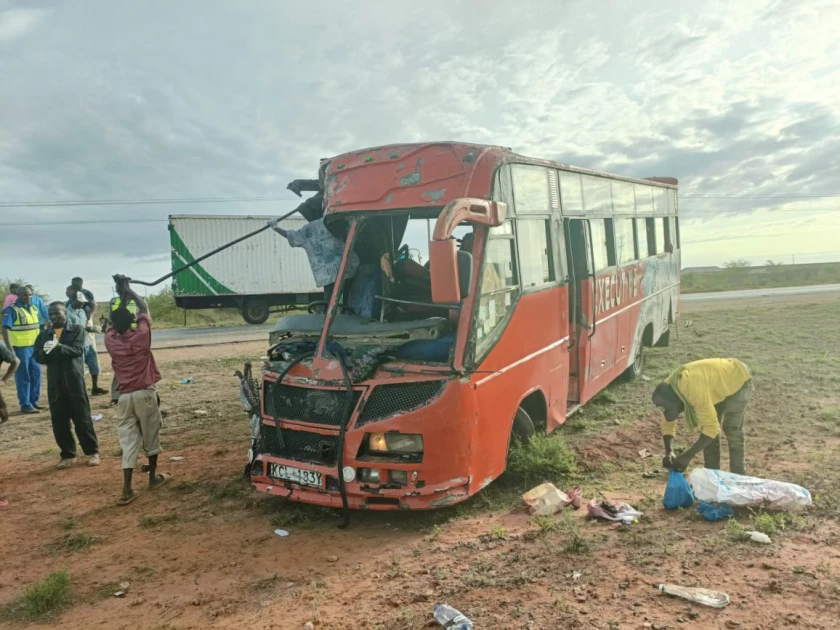
The news of the Chania Executive bus crash on March 5, 2026, which claimed six lives at the Manyatta area in Voi, has become a tragically familiar headline. As the morning mist cleared to reveal the twisted wreckage of a passenger bus and a freight trailer, the nation was left with a haunting question: Why is this specific 10-kilometer stretch of the Nairobi-Mombasa highway becoming a graveyard?
To understand the tragedy, we must look beyond the immediate “human error” and perform a systemic audit of our roads, our driving culture, and our 2026 safety regulations.
1. The “Manyatta-Maungu” Triangle: A Geography of Danger
Traffic experts and long-distance drivers have long flagged the area between Voi and Maungu as a high-risk zone. There are three physical factors that make this spot a “perfect storm” for accidents:
The “False Sense of Security”: After the winding hills of the Coast region, the road at Manyatta opens up into a long, seemingly straight stretch. This encourages drivers to increase speed significantly.
The Overtaking Trap: Because the highway remains a single-carriageway in most sections, fast-moving buses often attempt to overtake slow-moving, heavy-duty trailers. At 5:00 AM—the time of the Chania crash—visibility is at its lowest, and depth perception is skewed.
The Narrowing Effect: Local residents note that certain sections near Manyatta have eroded shoulders. When two large vehicles meet at high speed, there is zero “buffer room” for error.
2. 2026 Data: A Worrying Upward Trend
The National Transport and Safety Authority (NTSA) recently released a somber report for the first quarter of 2026.
Key Statistic: Road fatalities in Kenya rose by 3.4% in 2025, and the first 60 days of 2026 suggest we are on an even deadlier trajectory.
According to NTSA data, the Nairobi-Mombasa highway accounts for nearly 22% of all highway fatalities in the country. The “Dawn Hours” (3:00 AM to 6:00 AM) are identified as the “Red Zone,” where driver fatigue from overnight travel intersects with the peak movement of cargo trailers heading to the Port of Mombasa.
3. The “Human Factor”: Overtaking on Yellow Lines
Coast Traffic Boss Asha Wario noted that the trailer in the March 5 crash “left its proper lane.” This points to a deeper issue in Kenyan driving culture: Lane Indiscipline.
In 2026, despite the introduction of mobile traffic courts and digital speed governors, the pressure on PSV (Public Service Vehicle) drivers remains immense.
The “Turnaround” Pressure: Drivers are often forced by Saccos to meet strict timelines to maximize trips.
Fatigue Management: Many long-distance drivers report working shifts exceeding 14 hours, far beyond the recommended 8-hour limit set in the 2024-2028 National Road Safety Action Plan.
4. Infrastructure vs. Enforcement: What is the Solution?
If we are to move beyond sending “condolences,” the 2026 safety agenda must prioritize three radical shifts:
A. Immediate Dualing of Black Spots
The most effective way to stop head-on collisions like the Chania-Trailer crash is to eliminate the possibility of meeting oncoming traffic. KeNHA must prioritize dualing short, 5-kilometer “high-risk zones” like Manyatta and Miasenyi immediately.
B. Digital “In-Cab” Monitoring
The technology exists. In Europe and parts of Asia, heavy-duty trucks and buses are fitted with Electronic Logging Devices (ELDs) that automatically shut down the engine or alert authorities if a driver exceeds legal driving hours.
C. The “Manyatta” Lighting Project
Investing in solar-powered street lighting for known black spots would drastically reduce dawn and dusk accidents. A well-lit road is a safer road.
5. A Message to the 2026 Traveler
While we wait for policy changes, the responsibility falls on us. As a passenger, you have the right—and the duty—to speak up when a driver is overtaking recklessly.
The Survival Checklist:
Avoid Dawn Travel: If possible, book buses that arrive or depart during full daylight.
Monitor the Driver: Use apps like NTSA’s “Abiria” to report speeding in real-time.
Seatbelt Compliance: It remains the single most effective way to survive an impact.