

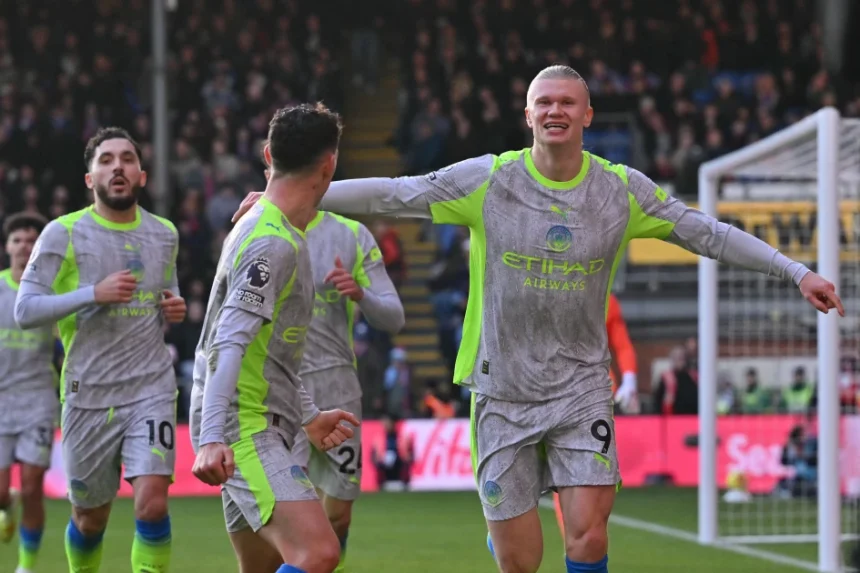
When Erling Haaland celebrates a goal, there’s a cold, almost mechanical intensity in his eyes—no excessive euphoria, just a sharp focus on the next chance. In an era where football celebrates flair, personality, and expression, Haaland represents something different: the psychology of pure, uncompromising efficiency.
His brace against Crystal Palace wasn’t just about physical prowess; it was a masterclass in mental fortitude. While others feel pressure, Haaland seems to convert it into laser-guided focus. This blog explores the psychological architecture behind football’s most relentless goal machine.
1. The “Iceberg” Mentality: What We See vs. What Drives Him
Visible (The Tip):
Celebrations: Minimal, business-like.
Interviews: Direct, unemotional, focused on team.
On-pitch demeanor: Controlled aggression.
Beneath the Surface (The Bulk):
Hyper-competitive self-talk: “I must score. I will score.”
Visualization rituals: Picturing goals before games.
Emotional regulation: Channels adrenaline into precision, not panic.
Analogy: He’s not a passionate artist; he’s a surgeon with a football.
2. Key Psychological Traits That Define Haaland
Trait How It Manifests Example from Palace Game
Process Over Outcome Focuses on movement, timing, not just goals Made 12 off-ball runs before his first goal
Selective Amnesia Forgets misses instantly; remembers patterns Missed chance in 25’; scored in 38’
Controlled Aggression Physical but rarely emotional Held off defenders without retaliating
Extrinsic Motivation Uses criticism as fuel Responded to “flat-track bully” tags with big-game goals
Routine Dependency Pre-match rituals create mental readiness Same warm-up, same focus cues
3. The Making of a Mentality Monster: Nature vs. Nurture
Genetic & Early Influence:
Father (Alf-Inge): Premier League experience taught resilience against criticism.
Athlete genes: Mother heptathlete—competition ingrained early.
Developmental Environment:
Molde (Norway): Learned in a low-pressure, high-freedom system.
Salzburg (Austria): Adapted to different styles, built tactical IQ.
Dortmund (Germany): Handled hype and expectation in a selling club.
Manchester City: Thrives under Guardiola’s detail-obsessed culture.
4. Comparative Psychology: Haaland vs. Other Elite Strikers
Player Primary Mental Drive Celebration Style Pressure Response
Erling Haaland Ruthless efficiency Minimal, focused Ice-cold focus
Harry Kane Leadership & responsibility Passionate, pointed Leads by example
Kylian Mbappé Flair & legacy-building Flashy, confident Rises in big moments
Robert Lewandowski Perfectionism & professionalism Determined, intense Clinical under stress
Mohamed Salah Joy & inventive expression Emotional, grateful Expressive, sometimes frantic
Verdict: Haaland’s psychology is outcome-obsessed, not performance-obsessed. He cares about the net, not the narrative.
5. The “Next Ball” Philosophy: How Haaland Stays in the Moment
His Own Words:
“When I miss, I think: next chance. When I score, I think: next chance. Always next.”
Neuroscience Behind It:
Cognitive Tunneling: His brain filters out crowd noise, opponents’ trash talk, and even scoreline pressure.
Dopamine Regulation: Treats goals as expected outcomes, not euphoric rewards—maintains hunger.
Practical Effect:
Never gets complacent after scoring.
Never gets frustrated after missing.
Result: Consistent output across 90 minutes.
6. How Opposition Defenders Psychologically Prepare for Haaland
Mental Challenges They Face:
Intimidation by Reputation: Entering a duel they’re “expected” to lose.
Physical Presencing: His size and speed create psychological fatigue.
Constant Alertness: He never “switches off”—defenders must match that focus.
What Some Defenders Have Said:
Virgil van Dijk: “You must think two steps ahead, but he’s already there.”
Rúben Dias (teammate, in training): “His concentration is unnatural. He doesn’t have bad days.”
7. Guardiola’s Role: Cultivating a Machine
Pep doesn’t coach Haaland’s mentality—he channels it:
Task-Specific Focus: “Your job is here, in this zone, at this time.”
Feedback Style: Data-driven, not emotional—uses video clips, not speeches.
Load Management: Rests him physically to keep him mentally sharp.
8. The Potential Downside: Is This Mentality Sustainable?
Risks:
Emotional Bottling: Could lead to burnout if not managed.
Team Dynamics: Teammates might find him “distant” or “too serious.”
Injury Comebacks: Relies on routine—disruption could affect mental rhythm.
Mitigations:
Strong support system: Close family, trusted agents.
Balanced off-field life: Enjoys chess, gaming, nature—mental escapes.
Long-term vision: Already planning post-career business ventures.
9. Lessons for Aspiring Athletes (and Professionals)
Transferable Mental Skills:
Compartmentalization: Separate emotion from execution.
Routine as Anchor: In chaos, routine creates control.
Selective Listening: Hear useful feedback, ignore noise.
Visualization: See success before it happens.
Next-Play Mentality: Don’t dwell on past mistakes or successes.
Haaland’s Advice (paraphrased):
“Control what you can control. The rest is decoration.”
Conclusion: The Psychology of inevitability
Erling Haaland has weaponized a simple, repeatable, ruthless mental framework:
Identify target → Eliminate distraction → Execute → Repeat.
In doing so, he hasn’t just become a great scorer—he’s created a psychological aura of inevitability. Defenders don’t just fear his physicality; they fear his unshakeable certainty that he will score.
As the title race intensifies, this mentality may be Manchester City’s ultimate weapon. Because while talent can win games, mindset wins championships.
Self-Reflection:
Which of Haaland’s mental traits could you apply in your own profession or passion? Is “cold efficiency” an advantage or a limitation in team environments?