

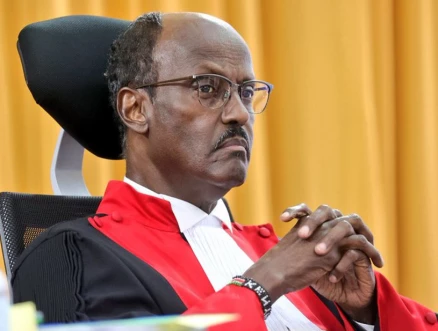
The gavel has fallen for the final time. Kenya awoke to the solemn news that Justice Ibrahim Mohammed of the Supreme Court has died, marking a profound moment of national reflection. More than a judge, Justice Mohammed served as a living pillar of our constitutional democracy—a scholar in robes whose quiet demeanor belied a formidable legal intellect that shaped the destiny of the nation. His passing creates a silence in the highest court of the land, a silence that echoes the weight of his contributions. This tribute moves beyond the headlines to examine the man, his monumental rulings, and the indelible legacy of Justice Ibrahim Mohammed on Kenya’s quest for a just society.
Section 1: Architect of Precedent: From Paper to Principle
Justice Mohammed’s career was a masterclass in transforming constitutional text into lived reality. His judgments were blueprints for justice.
The Electoral Justice Vanguard: He was a central architect in the Supreme Court’s groundbreaking 2017 Presidential Election nullification. His legal reasoning helped cement the principle that electoral technology must serve the people’s will, not subvert it, setting a global benchmark for judicial courage.
Defender of Devolution: In fierce disputes over revenue sharing, his opinions were pivotal. He famously argued that county governments were not mere administrative units but sovereign entities deserving of dignity and predictable funding, thus protecting devolution from central overreach.
The People’s Magistrate: In a landmark ruling on public participation, he asserted that the government’s duty to consult citizens was not a “tick-box exercise” but a substantive constitutional requirement, empowering communities across Kenya.
Section 2: The Mind Behind the Judgment: A Jurist’s Philosophy
To understand his impact, one must understand his judicial philosophy.
Textualist with a Soul: He believed first in the plain meaning of the Constitution and statute. However, he tempered this with a profound understanding of the spirit of the law, ensuring outcomes that affirmed human dignity and social justice.
The Consensus Builder: Within the Supreme Court, he was renowned not as a dissenter, but as a meticulous craftsman of consensus. He would often bridge differing judicial opinions to forge strong, unanimous decisions that carried greater legitimacy.
A Teacher on the Bench: His written judgments were remarkably clear, often explaining complex legal principles in accessible language. He saw each ruling as an opportunity to educate the bar, the bench, and the public on the Constitution.
Section 3: Tributes from the Corridors of Power and Beyond
The outpouring of grief underscores his unique standing across Kenya’s spectrum.
From the Executive: A statement from State House recognized him as “a servant of the people whose work fortified the foundations of our nation’s legal system.”
From the Legislature: Leaders from both sides of the aisle praised his non-partisan integrity. The Speaker of the National Assembly noted, “He judged the law, not the political winds.”
From Civil Society: Human rights defenders and governance activists hailed him as a reliable ally in court, a judge who viewed the Constitution as a shield for the vulnerable.
A Personal Loss: Colleagues recall a man of deep faith, humility, and dry wit—a cherished friend who valued family above all else.
Section 4: The Path Forward: Merit, Process, and National Anxiety
Filling this vacancy is the next critical test for Kenya’s institutions.
A Litmus Test for Judicial Independence: All eyes will be on the Judicial Service Commission (JSC). Will the process be transparent, merit-based, and insulated from political lobbying? The credibility of the Supreme Court is at stake.
The Profile of a Successor: The nation needs a jurist who embodies Justice Mohammed’s qualities: intellectual independence, courage, and an unshakeable fidelity to the Constitution. The nominee must be beyond reproach.
A Moment of National Choice: This is more than an appointment; it is a statement about the kind of judiciary Kenya wants for its future.
Conclusion: The Judgment of History
The chapter of Justice Ibrahim Mohammed’s life has closed, but its narrative is permanently woven into Kenya’s story. He demonstrated that in a young democracy, the most powerful tool is not rhetoric from a podium, but reasoned judgment from a bench. He proved that legitimacy is earned through consistency, not charisma. As we mourn, we must also recommit to the values he upheld: the supremacy of the Constitution, the independence of the judiciary, and the unwavering pursuit of justice for all Kenyans, high and low. His greatest legacy would be a nation that refuses to lower the standard he set.
His Work is Done. May He Find Perfect Justice.