

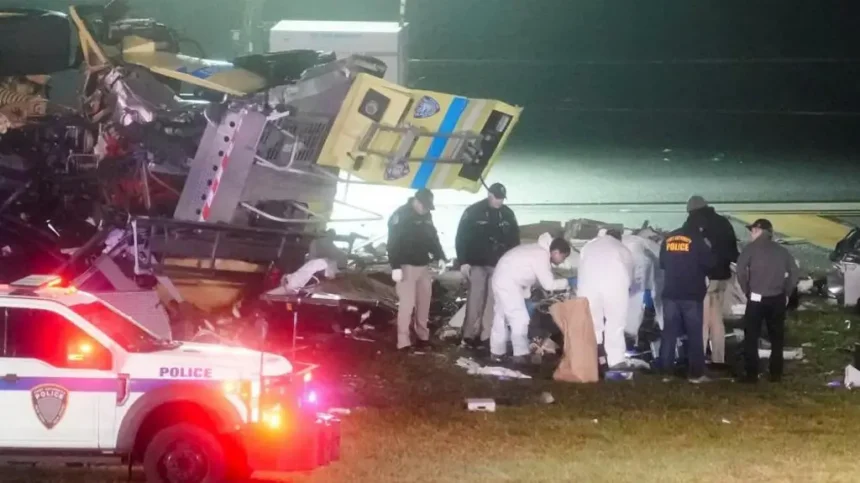
As the clock ticks past 3:00 PM in New York on Monday, March 23, 2026, the silence at LaGuardia Airport is deafening. Usually one of the busiest hubs in the world, the runways are currently occupied only by NTSB investigators and cleanup crews. The tragic death of two Canadian pilots in a late-night collision has shifted the conversation from “what happened” to “how was this allowed to happen?”
The collision between Air Canada Express Flight 8646 and Port Authority Truck 1 was not just a tragic accident; it was a systemic failure where multiple layers of safety protocols—designed specifically to prevent this exact scenario—collapsed simultaneously.
The “Emergency Overlap” Theory
Investigators are currently exploring the “Emergency Overlap” theory. The fire truck was responding to a separate odor-related emergency on United Airlines Flight 2384. In the high-pressure environment of managing a grounded emergency and incoming international traffic, a critical hand-off error occurred.
The Communication Loophole:
The Clearance: Recordings show Truck 1 was cleared to cross Runway 4.
The Contradiction: At the same time, the Tower controller was monitoring Flight 8646 on its final “short final” approach.
The Fatal Seconds: The “Stop, stop, stop!” command was issued only after the truck had already entered the runway’s safety envelope.
Why Technology Failed: The ASDE-X Question
LaGuardia is equipped with ASDE-X (Airport Surface Detection Equipment), a highly sophisticated system meant to alert controllers to “runway incursions.”
The Mystery: Why didn’t the system’s auditory and visual alarms trigger in time to stop the landing jet or the crossing truck?
Weather Factors: Heavy rain and standing water were reported at LGA on Sunday night. Investigators are looking into whether the weather “blinded” ground sensors or if there was a software latency issue during the dual-emergency coordination.
The Human Cost: Honouring the Jazz Aviation Crew
While the aviation world talks tech, the Jazz Aviation community is in mourning. The two pilots—both highly experienced and based in Canada—are being remembered as dedicated professionals. Air Canada’s “Care Team” is currently on the ground in Montreal and New York to support the families.
Out of the 72 passengers, 9 remain in serious condition. Hospitals in Queens report that injuries range from severe concussions to fractures caused by the sudden deceleration—the jet went from landing speed to a near-halt in a matter of seconds upon striking the heavy fire vehicle.
What Happens Next? The Reopening Timeline
The FAA’s initial 2:00 PM ET reopening time has been pushed back.
Site Documentation: The NTSB must finish laser-scanning the debris field before the aircraft can be towed.
Runway Integrity: Engineers must inspect the tarmac for structural damage caused by the impact and the fuel spill.
The “Safety Check”: Before the first takeoff, the Port Authority must recalibrate all ground sensor systems to ensure no recurring glitches.
Conclusion: A Wake-Up Call for 2026
The LaGuardia collision will likely be the catalyst for a massive overhaul of Airport Rescue and Firefighting (ARFF) protocols. In an era where we aim for “zero accidents,” the fact that a landing passenger jet and a rescue truck could occupy the same space on a New York runway is a sobering reminder that human and technological limits still exist.
For thousands of travelers, today is a day of frustration. For the families of two Canadian pilots, it is a day of profound tragedy. For the aviation industry, it is a day for an honest, painful look in the mirror.