

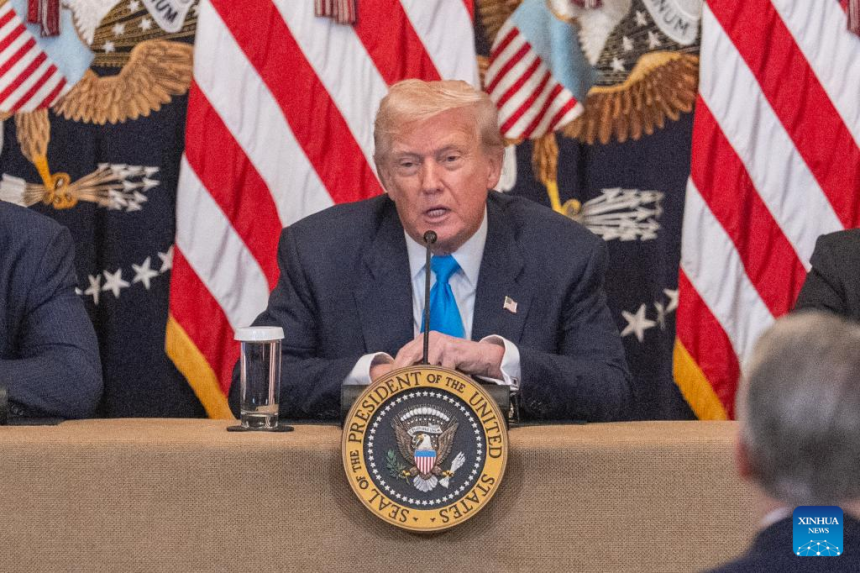
For months, the White House has treated the military theater of Operation Epic Fury as a series of clean, clinical victories. The administration has repeatedly pointed to the elimination of Iran’s top leadership, a 90% degradation of Tehran’s drone and missile production assets, and the successful enforcement of a naval blockade.
The White House
But as the temporary April ceasefire disintegrates into a chaotic cycle of regional retaliation, the true domestic bill for this conflict is finally coming due.
Behind the closed doors of Capitol Hill, a explosive political civil war is brewing. The catalyst? A staggering $200 billion supplementary military funding request submitted by the Pentagon to replenish depleted American stockpiles. For a president who built his political brand on ending “endless foreign wars” and conserving American capital, this massive fiscal demand is fracturing his own base, igniting a fierce rebellion among MAGA isolationists who feel fundamentally betrayed.
Wikipedia
The Human and Fiscal Ledger: What the War Has Cost So Far
The administration’s public narrative of a low-risk, high-reward intervention is being heavily challenged by the hard math of modern warfare. In just the opening months of the conflict, the Pentagon quietly burned through nearly $29 billion in direct operational costs—deploying aircraft carrier strike groups, launching precision munitions, and providing round-the-clock air defense support to regional allies.
Wikipedia
More soberingly, the conflict has pierced the armor of American isolation. Official Department of War records confirm the human cost of the intervention:
15 American service members have been killed in action.
Wikipedia
543 military personnel have been wounded or severely injured, primarily due to localized drone and ballistic missile counter-strikes targeting vulnerable U.S. logistics hubs in the Gulf.
With Iranian Parliament Speaker Mohammad Bagher Ghalibaf now declaring all regional U.S. bases as active targets following Israel’s unilateral strikes, military planners warn that both the financial and human costs will scale exponentially without a rapid diplomatic off-ramp.
The MAGA Civil War: Isolationists vs. Hawks
The $200 billion funding request has exposed a deep, ideological fault line within the Republican party. For traditional GOP defense hawks, the funding is a non-negotiable necessity to maintain global deterrence and protect international energy lanes.
However, a highly vocal faction of America First populist lawmakers is actively digging in their heels, refusing to write a blank check for a war they believe should never have been started.
“We were promised an end to endless nation-building and foreign entanglements. Instead, we are $29 billion in the hole, looking at a $200 billion request that dwarfs our domestic border security budget, all while American soldiers are coming home in caskets. This isn’t America First—it’s a rerun of the old neoconservative playbook.”
Wikipedia
— Anoymous House Freedom Caucus Member
The Ideological Divide: Splitting the Right
The battle lines over the supplementary defense bill highlight how heavily the ongoing conflict has complicated the party’s standard legislative cohesion.
The Congressional GOP Fracture Matrix
Faction Grouping Core Legislative Stance Primary Argument Against / For Political Risk Factor
MAGA / Populist Isolationists Firm No on the full $200B package without extreme domestic spending offsets. The war violates Trump’s core campaign promise to keep America out of Middle Eastern quagmires. Risks alienating the core anti-interventionist voter base ahead of the 2026 midterms.
Traditional / Establishment Hawks Unconditional Yes to maintain military supremacy and back Israel. Failing to pass the bill signals catastrophic weakness to Beijing, Moscow, and Tehran. Invites fierce, well-funded primary challenges from populist insurgencies at home.
The White House Centrists Conditional Push to pass a scaled-back, “compromise” defense package. The funds are legally required to replenish domestic missile defense interceptor stockpiles. Trapped between maintaining executive military authority and surviving a base revolt.
The Rhetoric vs. The Reality
The fundamental vulnerability for President Trump is the massive gap between his public declarations and the geopolitical reality on the ground. On multiple occasions, Trump has taken to social media to claim complete victory, asserting that Iran has “nothing left in a military sense.”
Wikipedia
Yet, the sheer scale of the Pentagon’s $200 billion request proves the exact opposite: the Islamic Republic’s conventional and asymmetric capabilities remain resilient enough to force the U.S. military into a massive, prolonged, and highly expensive defensive posture.
As the bill heads toward a high-stakes committee review, the administration finds itself completely jammed. To secure the funding needed to protect American troops currently locked in a dual-blockade standoff in the Strait of Hormuz, Trump must cut a deal with the very establishment hawks he spent years criticizing—all while watching his own populist coalition threaten to jump ship.
Master Blog Index Concluded
Blog 1: The Economic Crisis: Surging Gas Prices, Inflation, and Trump’s Midterm Nightmare.
Blog 2: The Illusion of Control: How Netanyahu and Tehran Shattered Trump’s Peace Deal.
Blog 3: The Hidden Casualties: Inside the Pentagon’s Secret Supplementary Funding Battle and the Growing MAGA Rebellion.
Now that the complete three-part analytical series on the 2026 U.S.-Iran War is finalized, would you like me to construct an optimized email newsletter blast or a high-engagement LinkedIn summary to drive your digital audience directly to these articles?