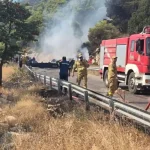

As the smoke finally clears over the charred remains of the Gorofani and fish sections at Nairobi’s Gikomba Market, the conversation on the ground has rapidly shifted from immediate grief to deep-seated political anger and demands for accountability.
With the Kenya Red Cross confirming that a grueling, 10-hour multi-agency battle was required to subdue the 4:00 a.m. inferno, the repetition of this disaster has ignited a fierce blame game. Local leadership, legal rights organizations, and devastated business owners are openly questioning whether the frequent blazes are truly accidental—or rather a weaponized tool used by cartels to aggressively displace informal traders from one of the capital’s most lucrative public plots.
Moving Beyond Sympathy: The Push for Real Compensation
For years, the standard government response to a Gikomba fire has followed a predictable routine: high-ranking county and national officials tour the smoking wreckage, promise swift investigations, offer temporary food distributions, and pledge to construct modern, fireproof market stalls.
However, following Sunday’s massive destruction, the legal and political community is drawing a hard line. Prominent human rights advocate and former Law Society of Kenya (LSK) President Faith Odhiambo has publicly demanded that the state move past repetitive public relations messages and establish an immediate, legal framework to financially compensate the victims.
The Eastleigh Voice
“No family should have to repeatedly rebuild from ashes while questions about safety, accountability, and lasting solutions remain unanswered,” Odhiambo declared in a strongly worded statement. “Today, we stand in solidarity with Gikomba traders and commit to amplifying their cry for justice, compensation, and meaningful reform so that ‘never again’ finally means something.”
The Star
[ Traditional Policy ] ──> Sympathy Messages ──> Temporary Food Aid ──> Market Burned Again
│
(THE POLICY SHIFT DEMAND)
▼
[ Proposed Reform ] ──> Ironclad Court Compensation ──> Structural Market Planning ──> Permanent Protection
The Land Grabbing Factor: Is It Sabotage?
The primary driver behind the growing fury on the ground is the highly controversial history of the trading hub. Gikomba is not just an open-air market; it is prime real estate located right on the periphery of Nairobi’s Central Business District (CBD).
Because the vast majority of merchants operate on communal public land or temporary permits, the area has long been targeted by private developers and informal syndicates. Traders in the clothing and footwear wings note a suspicious pattern: fires almost always strike in the dead of night, typically during weekends when the market is at its peak capacity with new, high-value wholesale stock.
The political opposition has warned that the continuous destruction of small-scale citizen livelihoods will carry heavy political consequences in upcoming local elections if the Ministry of Interior fails to permanently secure the market’s boundaries against encroachment.
People Daily
Systemic Failure: Nairobi’s Broken Disaster Preparedness
Beyond the conspiracy theories, Sunday’s 10-hour struggle laid bare the dangerous, systemic weaknesses plaguing Nairobi County’s emergency response frameworks.
People Daily
Despite millions of shillings allocated toward urban safety, first responders faced the exact same structural bottlenecks that have crippled firefighting efforts for decades:
Impenetrable Pathways: Decades of uncoordinated construction have allowed stalls to spill directly into designated access roads, making it physically impossible for heavy fire engines to reach the center of the blaze.
The Non-Functional Hydrant Crisis: Fire trucks were repeatedly forced to drive miles out of the Majengo and Kamukunji areas just to refill their water tanks, as localized market hydrants lacked sufficient pressure or water supply.
A Static Fire Station: While a modern Gikomba Fire Station was built directly adjacent to the market to prevent this exact scenario, merchants claim its localized assets are under-staffed and lacked the immediate tactical deployability needed to contain the fire within its initial 30-minute breakout window.
What Happens Next?
As the Directorate of Criminal Investigations (DCI) teams sift through the ash to locate the physical origin of the fire, Gikomba’s trading community faces a familiar, painful choice. Without an official state cushion, many will be forced to take out high-interest informal micro-loans just to restock their stalls.
However, with prominent legal minds stepping in to organize the traders into a unified front for compensation, the aftermath of this specific fire might look very different. The coming weeks will reveal if Nairobi’s leadership will finally address the systemic vulnerabilities of Gikomba, or if the market will simply remain a ticking time bomb waiting for the next spark.