

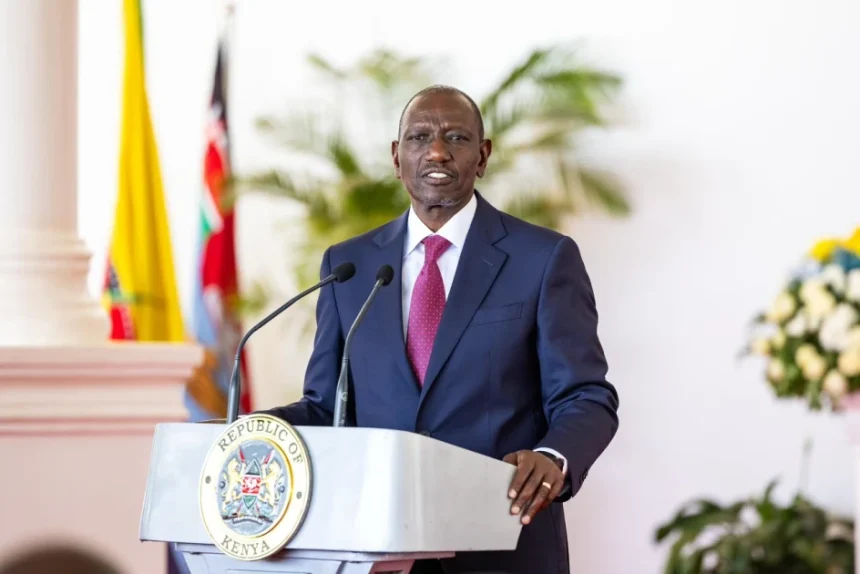
In political communications, framing is everything. When President William Ruto stood before the nation to unveil an ambitious roadmap intended to redefine Kenya’s growth trajectory beyond Vision 2030, the executive goal was to inspire confidence, invoke national unity, and reframe the narrative around structural economic recovery.
Drawing historical parallels to the industrial transformations of South Korea, Singapore, and Vietnam, the President called on every citizen to participate in a “consequential national conversation” about the country’s development charter.
Yet, almost before the official broadcast feed ended, the digital public square delivered its own verdict.
Summarized across social media feeds, radio talk shows, and street corner discussions in three dismissive Swahili words—”Ni kelele tu” (It’s just noise)—Kenyans rejected the grand economic visioning in favor of pressing, unresolved everyday crises.
This divergence isn’t just a social media trend; it highlights a deep breakdown in executive communication. Why are Kenyans increasingly tuning out major policy speeches? What makes “Ni kelele tu” such a potent phrase in contemporary Kenyan politics?
The Vision vs. The Reality: Deconstructing the Speech
During his address, President Ruto framed Kenya at a critical historical juncture, comparing the nation’s trajectory to global economic success stories:
The Historical Comparison: Noting that in 1965, Kenya and South Korea shared similar GDP per capita benchmarks (around $110 USD), whereas South Korea’s GDP per capita today exceeds $36,000 USD compared to Kenya’s $2,400 USD.
Macroeconomic Foundations: Pointing to stabilized inflation, foreign exchange reserves reaching historic peaks, and improved international competitiveness rankings as proof that the worst economic storm has passed.
The Post-Vision 2030 Charter: Proposing a new long-term national development blueprint to replace Vision 2030 as it nears its horizon, backed by institutions like the Sovereign Wealth Fund and the National Infrastructure Fund.
+—————————————————————————–+
| THE ANATOMY OF PUBLIC SKEPTICISM |
+—————————————————————————–+
| |
| EXECUTIVE SPEECH FOCUS CITIZEN IMMEDIATE PRIORITY |
| ———————- ————————– |
| • Multi-decade visioning • Today’s unga & transport costs |
| • Comparative GDP historical stats • Functional health insurance |
| • Foreign Direct Investment growth • Domestic youth employment |
| • National Infrastructure Funds • Lower tax & statutory burden |
| |
+—————————————————————————–+
On paper, outlining a multi-decade national strategy is standard statecraft. However, to a populace grappling with high taxation, systemic public healthcare transitions, and youth unemployment, asking citizens to contemplate 20-year development charter goals feels disconnected from immediate survival needs.
Why “Ni Kelele Tu” Struck a Chord
The phrase “Ni kelele tu” has evolved into a concise critique of executive rhetoric. Several factors explain why public skepticism has reached this pitch:
1. The Disconnect Between Macro-Stats and Micro-Realities
Statistical metrics like foreign exchange reserves, currency stabilization, or competitiveness rankings mean little to households struggling with high utility bills, school fees, and stagnant income. When a government points to macroeconomic indices as evidence of prosperity while local purchasing power remains strained, citizens feel their lived experiences are being dismissed.
2. Speech Fatigue and Unfulfilled Promises
Over the past two years, Kenyans have been presented with numerous ambitious policy rollouts—from the Affordable Housing levy to the Social Health Authority (SHA) and digital job initiatives. As operational glitches and rising costs persist within these programs, each subsequent televised address faces higher levels of public cynicism.
3. A Highly Literate, Fact-Checking Digital Public
Kenya’s youth-led digital ecosystem reacts in real time. Rather than passively receiving presidential addresses, online communities instantly cross-reference executive statements against past campaign manifestos, current budgetary allocations, and ground-level realities. When official speeches highlight international comparisons without addressing immediate domestic challenges, memes like “Ni kelele tu” spread rapidly.
Side-by-Side Analysis: What Was Said vs. What Was Heard
To understand the communication breakdown, it helps to examine how executive messaging was perceived by the public:
What Executive Speeches Emphasize How the Public Hears It (“On the Ground”)
“Kenya must think beyond short-term political cycles.” “The government is deferring immediate relief in favor of distant promises.”
“Macroeconomic stability has been restored.” “My daily expenses haven’t decreased despite the official numbers.”
“We need a new national development charter.” “More policy documents won’t fix my broken health insurance card.”
“Labor export programs provide youth global jobs.” “There are no jobs created at home for educated young professionals.”
“We are holding national dialogues for consensus.” “More political talks that won’t translate to immediate service delivery.”
The Danger of Public Disengagement for Governance
When citizens dismiss state addresses as “just noise,” it points to a deeper institutional challenge: the loss of executive narrative control.
[Grand Policy Speeches] ➔ [Expectation Gap] ➔ [Operational Friction]
│
▼
[Diminished Public Trust] ◄── [“Ni Kelele Tu” Cynicism] ◄── [Public Disillusionment]
When public skepticism turns into disengagement:
Tax Compliance Becomes Resented: High tax rates are tolerated when public services work; when services stall, taxation feels purely punitive.
National Initiatives Lack Buy-In: Even well-intentioned long-term policies struggle to gain momentum when the public views them with suspicion.
Political Volatility Rises: Dismissing executive communication creates space for alternative populist voices and decentralized protest movements.
How the Administration Can Rebuild Executive Credibility
Restoring public trust requires shifting from grand visioning to immediate, verifiable results:
Prioritize Operational Delivery Over Vision Statements: Before launching multi-decade developmental charters, resolve immediate operational bottlenecks in healthcare systems (SHA), education capitation, and local business regulations.
Align Rhetoric with Daily Realities: Acknowledge genuine financial hardship in official addresses rather than relying heavily on abstract macroeconomic statistics.
Show Transparent Value for Taxation: Provide clear, publicly accessible accounting of how tax revenues are directly improving local infrastructure and healthcare facilities.
Focus on Local Employment Generation: Shift the primary economic narrative from exporting labor abroad to fostering domestic industrial and technological opportunities for young graduates.
Final Thoughts: Beyond the Speeches
The viral spread of “Ni kelele tu” serves as a clear indicator of citizen expectations. Kenya’s populace is politically engaged, highly informed, and increasingly demanding.
While long-term planning is essential for any nation, sustainable governance requires balancing future aspirations with immediate relief. Until official metrics align with household realities, the public response to executive speeches will remain clear: deliver results, not rhetoric.