

In the high-stakes world of presidential security, four seconds is an eternity.
Newly released CCTV footage from the night of April 25, 2026, has sent shockwaves through the intelligence community, providing a frame-by-frame look at how 31-year-old Cole Tomas Allen nearly altered the course of American history. The venue was the Washington Hilton; the event was the prestigious White House Correspondents’ Dinner (WHCD). While the elite of Washington sat blocks away from the stage where President Donald Trump was being entertained by an illusionist, a very real—and very deadly—drama was unfolding at the perimeter.
The Anatomy of a Breach
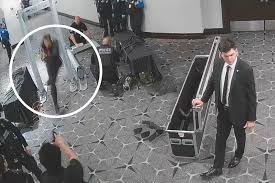
The video, shared by President Trump via Truth Social and later confirmed by federal authorities, begins at 8:36 p.m. It captures a man in dark clothing—identified as Allen—approaching a secondary security checkpoint located in the hotel’s basement level.
What happens next is a masterclass in chaotic efficiency.
In the footage, Allen doesn’t hesitate. He doesn’t try to talk his way through. Instead, he shifts into a full sprint, reportedly reaching speeds of up to 9 miles per hour. The “four-second” window refers to the time it took from his initial charge to the moment he bypassed the primary metal detectors and sprinted toward the inner ballroom corridor.
Security personnel, momentarily caught off guard by the sheer speed of the suspect, are seen reacting in a blur of motion. Weapons are drawn, and shouts of “Shots fired!” echo through the basement, though later reports suggest the gunfire likely came from a Secret Service agent’s weapon hitting Allen’s ballistic-protected area or Allen firing a shotgun at a responding officer.
Who is Cole Tomas Allen?
As the footage went viral, the question shifted from how to who. Investigators have since painted a portrait of a man who was as calculated as he was volatile. A former computer scientist and Caltech graduate, Allen had checked into the Hilton a day prior, likely using his status as a guest to bypass exterior security layers.
Before his sprint, Allen reportedly sent a manifesto titled “Apology and Explanation” to his family. In it, he described himself as a “friendly federal assassin,” listing administration officials in order of their rank. The chilling efficiency of his charge through the checkpoint suggests he had scouted the location, specifically targeting an unguarded stairwell to reach the basement screening area.
Inside the Ballroom: Ten Seconds of Terror
While the breach took four seconds, it took approximately ten seconds for the reality to hit the head table. At the time of the first shot, President Trump was watching a performance by Oz Pearlman. The footage from inside the room shows a stark contrast to the basement chaos: a sudden swarm of Secret Service agents, the frantic evacuation of Melania Trump, Vice President J.D. Vance, and Cabinet members like Marco Rubio and Robert Kennedy Jr.
The gala, intended to be a night of bipartisan levity, collapsed into a scene of abandoned chairs and guests diving for cover.
The Security Fallout
This incident has reignited a fierce debate over the “bubble” of presidential protection. How does a man armed with a handgun, a shotgun, and several knives get within 20 meters of a security checkpoint at a high-profile event?
Experts suggest that Allen’s status as a hotel guest gave him a “home-court advantage.” By staying 10 floors above the ballroom, he was able to move through internal service areas and stairwells that are often less scrutinized than the main entrances.
A New Era of Political Violence
The 2026 WHCD shooting is being cited as the third major security incident involving Donald Trump, following the events of 2024. It underscores a growing trend of political violence that has law enforcement agencies on high alert.
Despite the breach, the White House has remained defiant. Within two hours of the shooting, President Trump addressed the nation, and international leaders like King Charles III—who was on a state visit at the time—condemned the attack, stating that “such acts of violence will never succeed.”
Conclusion: Lessons from the Footage
The “four-second” footage serves as a grim reminder that security is only as strong as its weakest link. As the FBI continues to analyze Allen’s digital footprint and his “Apology and Explanation” manifesto, the focus remains on the Washington Hilton’s basement.
For the public, the video is a viral sensation. For the Secret Service, it is a document of failure that will be studied for decades. The investigation is ongoing, but one thing is certain: the perimeter of power is more porous than we ever imagined.