
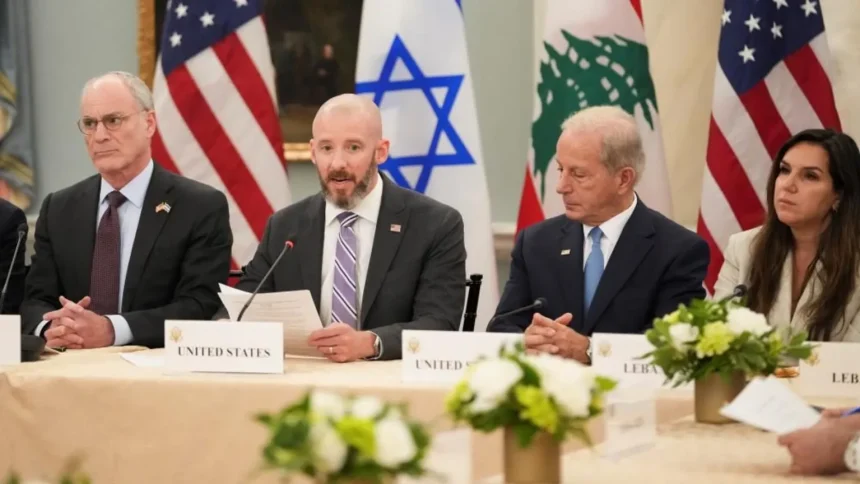
The high-level diplomatic agreements finalized inside the ornate rooms of the US State Department on Wednesday, June 3, 2026, paint a picture of structured, step-by-step stabilization. Under the watchful eye of Washington mediators, Israeli Ambassador Yechiel Leiter and Lebanese Ambassador Nada Hamadeh found common ground on a conditional ceasefire framework.
The Hindu
But as the ink dries on the joint declaration, the focus shifts entirely from international diplomatic tables to the rugged topography of southern Lebanon. The cornerstone of this US-brokered truce is the rapid creation of localized security “pilot zones”—designated sectors south of the Litani River where the Lebanese Armed Forces (LAF) are mandated to assume exclusive territorial control, completely pushing out Hezbollah and all other non-state armed actors.
The Jerusalem Post
While this strategy satisfies international legal requirements for state sovereignty, enforcing it on the ground is a monumental task. Within hours of the announcement, cross-border strikes, local casualties, and a tragic peacekeeping fatality highlighted the intense friction blocking Lebanon’s regular military from reclaiming its sovereign borders.
The Hindu
The LAF Dilemma: Funding, Logistics, and Moving into the Vacuum
For the pilot security zones to work, the Lebanese Armed Forces must quickly transition from a defensive border monitoring role to an active internal enforcement agency. According to the joint statement, the United States has pledged robust institutional and logistical assistance to improve the army’s operational capacity.
However, the structural realities facing the LAF are incredibly complex. Years of national macroeconomic instability have left the military underfunded, under-equipped, and heavily reliant on foreign financial stipends just to maintain basic troop retention.
“Lebanon committed to enhancing the capacity of the Lebanese Armed Forces, with US support, to assert effective control throughout the country… underscores our intent to enable the effective exercise of sovereignty.”
— Extract from the US State Department Joint Communiqué, June 4, 2026.
The Times of Israel
To successfully secure the south, the LAF faces an immediate three-fold logistical hurdle:
Troop Relocation: Deploying thousands of regular soldiers into volatile southern districts while maintaining domestic stability in Beirut and northern border points.
Asset Procurement: Acquiring advanced mobile communication networks, armored transport vehicles, and counter-drone defense systems to match the tactical environment.
Command Clarity: Navigating the highly sensitive political reality of actively disarming or displacing local Hezbollah operatives without triggering broader domestic civil friction.
The “Open City” Movement: Tyre’s Civil Rebellion
While military strategists debate logistics, an interesting civil movement is gaining rapid momentum among local populations weary of open warfare. In the historic coastal city of Tyre, residents are taking matters into their own hands through legal and administrative petitions.
The Hindu
Following targeted military intelligence reports alleging that militant cells were operating within Tyre’s Christian quarter, local leaders, intellectuals, and legal professionals launched a formal civic petition. The document, which has garnered over 180 prominent local signatures, officially demands that Tyre be declared an “Open City.”
The Hindu
The Tyre Civic Petition Mandate
Zero Armed Presence: The immediate removal of all partisan military installations, underground storage assets, and non-state fighters from civilian residential zones.
The Jerusalem Post
Exclusive Military Monopolies: A formal directive requesting the immediate, unhindered deployment of the Lebanese Armed Forces to establish checkpoints and control local security.
The Jerusalem Post
Protection of Cultural Heritage: Safeguarding the ancient city’s architectural and social history from becoming collateral damage in cross-border retaliatory strikes.
This grassroots push demonstrates that large segments of the Lebanese populace are eager to see the state reassert its formal authority, viewing the US-brokered pilot zones as a vital lifeline to rescue their local economies from endless conflict.
High Friction: Paramedics and Peacekeepers in the Crossfire
The urgent need for effective enforcement was laid bare by a series of violent incidents on Thursday, June 4, demonstrating that a diplomatic ceasefire on paper does not instantly stop active artillery exchanges on the ground.
The Hindu
In the Nabatieh district, the financial and human cost of the ongoing friction hit local emergency infrastructure directly. According to the National News Agency (NNA), an Israeli airstrike hit an ambulance team affiliated with the Islamic Health Committee in the town of Zibdine, resulting in the tragic death of one paramedic and leaving another severely wounded. Concurrently, a separate strike on a Lebanese military vehicle killed one regular soldier and wounded an officer near the border, drawing sharp condemnation from the LAF command regarding the deliberate targeting of state personnel.
The Hindu
Even more concerning for international observers was a severe artillery incident near Marjayoun, where heavy shelling struck a position held by the United Nations Interim Force in Lebanon (UNIFIL).
The Hindu
UNIFIL Position Shelled
Thursday, 08:00 AM
A targeted mortar and artillery barrage impacts an established UNIFIL observation outpost near Marjayoun in southern Lebanon.
Peacekeeper Fatality Confirmed
Thursday, 09:30 AM
UNIFIL command issues an official statement confirming that one international peacekeeper has been killed and two others heavily wounded in the attack.
Forensic Probe Launched
Thursday, 11:00 AM
United Nations forensic teams and military investigators launch an immediate inquiry to trace the exact trajectory and origin of the artillery rounds.
The Three-Week Verification Milestone
As the region processes these latest casualties, a strict diplomatic clock is ticking. The delegations from Beirut and Tel Aviv have agreed to return to Washington during the week of June 22, 2026, for a fifth round of direct political and security talks.
Arab News
The success of that upcoming summit depends entirely on what happens within the pilot zones over the next 20 days. If the Lebanese Armed Forces, backed by Western logistical support, can successfully position themselves along the Blue Line and demonstrate a true monopoly on security, it will pave the way for a historic, long-term boundary demarcation.
If non-state factions continue to launch retaliatory rocket barrages, or if unauthorized security elements refuse to vacate the South Litani sector, the pilot zone experiment will collapse. For Lebanon, the stakes could not be higher: it is a choice between reclaiming the structural protections of a sovereign state or remaining trapped in a cycle of proxy warfare.