

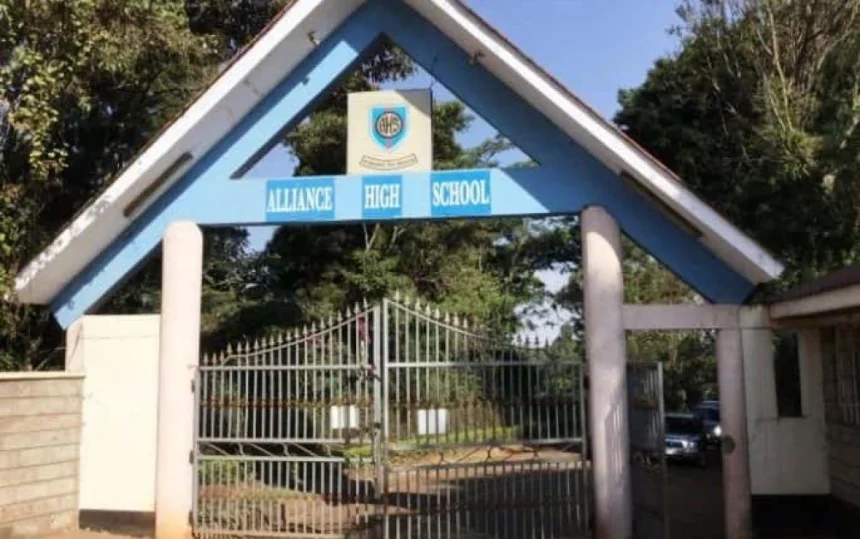
The smoke has cleared from the mattress store at Alliance High School, but the political and administrative fallout is just beginning to heat up across the nation. Coming less than a week after the horrific fire at Utumishi Girls Academy that tragically claimed 16 young lives, the containment of a 3:00 a.m. arson plot at an elite national institution has turned an isolated disciplinary problem into an urgent national security debate.
For decades, the traditional boarding school framework has been viewed as the gold standard of Kenyan secondary education—a structured space where top-performing students are insulated from external distractions to focus entirely on academic advancement. However, the current wave of unrest is forcing policymakers to confront a structural crisis that cannot be resolved through student suspensions alone.
As the Ministry of Education mobilizes multi-agency inspection teams to review safety compliance, the conversation in Parliament has taken a radical turn, with lawmakers openly questioning whether the Kenya boarding school safety policy is fundamentally broken, or if the boarding school model itself has outlived its usefulness.
Parliament Reacts: The 100% Transition Policy Under Fire
During a heated debate in the National Assembly following these consecutive institutional crises, legislators pointed directly to structural bottlenecks within the current education system. Rather than placing the blame entirely on moral decay or criminal intent among teenagers, several lawmakers argued that government policies have unintentionally compromised student safety.
A primary target of parliamentary criticism is the state’s aggressive 100% transition policy, which mandates that every child completing primary school must progress to a secondary institution. While highly successful at increasing national enrollment figures, the policy has not been matched by equivalent state investments in physical infrastructure.
“When you look at these institutions, even the high-end national schools, the dormitories are heavily congested. We have seen beds placed along narrow corridors and pushed right against exit doors. This rapid transition framework has outpaced our structural capacity, and we have collectively failed to protect our children.”
— Extract from Parliamentary Contributions on National School Safety, June 2026.
Emuhaya MP Omboko Milemba and Kisii Woman Representative Dorice Donya have gone as far as urging the Ministry of Education to consider phasing out public boarding facilities altogether for junior and secondary tiers, shifting instead to localized, well-funded day schools. They argue that day school structures reduce logistical vulnerability, lower regional overhead costs for parents, and eliminate the catastrophic risk of nighttime dormitory entrapment.
Blueprint vs. Reality: The Safety Standards Manual Baseline
The irony of Kenya’s recurring school fire crisis is that the solutions have been written down for nearly two decades. The Ministry of Education’s Safety Standards Manual for Schools (2008), alongside the updated Registration Guidelines for Basic Education Institutions, outlines explicit, non-negotiable architectural and operational mandates designed to protect learners.
The ongoing multi-agency audits launched this month indicate that a vast majority of public institutions are operating in gross violation of these statutory baselines. The table below matches the official legal requirements against the structural compromises frequently uncovered by inspectors on the ground:
Statutory Safety Metric Official MoE Manual Mandate (2008 / 2021) Common Institutional Compromise Immediate Risk Implication
Dormitory Door Design Must be at least 5 feet wide, open outwards, and never be locked from the outside at night. Padlocked externally by night guards to prevent students from sneak-outs. Total blockage of primary escape routes during a rapid smoke buildup.
Window Specifications Must be completely ungrilled, easily openable outwards, and function as secondary exits. Reinforced with heavy iron grilles to prevent theft or unauthorized entry. Students are effectively caged inside a burning room if the main doors are compromised.
Spatial Bed Allocation All beds must be spaced at least 1.2 meters apart, with central corridors maintained at 2 meters wide. Triple-decker beds packed tightly together; corridors blocked by metallic storage trunks. Severe crush hazards and slow evacuation times during a nighttime emergency stampede.
Active Fire Suppression Serviced fire extinguishers mounted at each exit; functional alarms with independent power backups. Expired cylinders kept locked in administrative offices; non-existent smoke detection. Inability to suppress localized fires before they breach structural ceiling boards.
Operational Oversight Mandatory, documented, unannounced evacuation drills conducted at least once per term. Drills treated as a one-off paperwork ritual at the start of the academic year. Widespread student panic, confusion, and a lack of clear assembly protocol during an actual crisis.
Evaluate Dormitory Compliance Risks Instantly
To help school boards of management, administrative heads, and concerned parents objectively evaluate their current accommodation facilities against the strict provisions of the Safety Standards Manual, the tool below calculates localized safety ratings based on core structural inputs.
An institutional compliance rating drops drastically whenever a foundational safety rule—such as window grilles or external locks—is compromised. Adjust the operational parameters below to see how minor infrastructure adjustments directly alter a building’s overall defensive safety posture.
Interactive visual ready
Systemic Enforcements Facing School Administrators
Following the closure of Alliance High School and the widespread investigations handled by the Directorate of Criminal Investigations (DCI), Basic Education Principal Secretary Belio Kipsang has issued a strict directive to all regional directors of education. The state is shifting from advisory warnings to immediate administrative punishments.
1. Mandatory De-escalation of Enrolment Caps
Schools found to have higher student numbers than their registered physical bed capacity are being ordered to immediately halt further admissions for the upcoming terms. Sub-county education boards have been empowered to redistribute excess learners to neighboring day schools if regional boarding facilities cannot expand their infrastructure to meet the 1.2-meter bed spacing rule before the end of the current financial year.
2. Personal Liability for School Principals
In a major departure from past protocols where institutional mishaps were absorbed by the Ministry, school heads will now face individual criminal and civil negligence charges if a fire occurs in a dormitory that fails basic safety audits. If doors are found padlocked from the outside or window grilles are present during an incident, the head of the institution will be prosecuted for reckless endangerment under the Basic Education Act.
3. Strict Funding Adjustments
Because infrastructure maintenance is heavily hit by current economic constraints, the state has clarified that school management boards must prioritize safety over cosmetic campus upgrades. Funds collected through local development levies must be channeled into installing interconnected smoke alarms, purchasing fire cylinders, and retrofitting exit doors before any investments are made in secondary projects like school buses or sports pavilions.
Understanding the financial policies shaping public institutions can help families contextualize these infrastructure challenges; for instance, the government continues to enforce strict caps on public tuition costs, which leaves administrators with tight operating margins to address safety retrofits.
The recurring tragedies in our boarding institutions prove that safety is not a luxury upgrade—it is a baseline legal obligation. Resolving Kenya’s school unrest requires looking beyond student disciplinary tracking to fix the systemic overcrowding and infrastructure gaps that place young lives at risk every night.
For additional context on the financial regulations and structural guidelines currently governing public institutions during these infrastructure reviews, you can check out this Ministry of Education Fee Structure Assessment. This report covers official government declarations regarding public school resource allocations, detailing how national caps on funding impact how local school boards maintain their facilities during major policy shifts.