

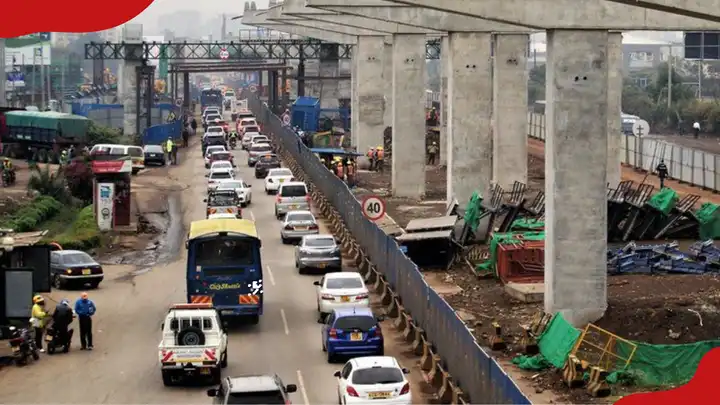
The temporary closure of Nairobi’s primary transport artery this weekend involves a massive logistical and structural engineering operation. When the Kenya National Highways Authority (KeNHA) halts all traffic on sections of Mombasa Road (A8) and the Nairobi Expressway, it will launch a precise, fast-tracked infrastructure deployment.
The 24-hour engineering window runs from Saturday, June 13, 2026, at 10:00 PM to Sunday, June 14, 2026, at 10:00 PM.
During this time, heavy lifting crews will mount massive, pre-fabricated steel structural beams for the new Airtel Footbridge. Balancing a rapid construction timeline with active public safety requires temporary adjustments to the city’s traffic flow.
The Structural Challenge: Spanning Two Decks of Traffic
The construction of the Airtel Footbridge presents unique structural engineering challenges due to the layout of the corridor. Unlike standard pedestrian footbridges that cross a single multi-lane highway, this project must span two entirely independent, layered transport decks:
The Lower Deck: The multi-lane lower Mombasa Road (A8) carriageway, which handles high-volume industrial freight and public transport vehicles.
The Upper Deck: The elevated, concrete dual-carriageway of the Nairobi Expressway toll road.
CROSS-SECTIONAL STRUCTURAL MATRIX
[ THE AIRTEL FOOTBRIDGE PRE-FABRICATED SPAN ] ◄── CRANE LIFTS HERE
=============================================================
[ UPPER DECK: Nairobi Expressway Carriageway ] ──► (Closed Both Ways)
─────────────────────────────────────────────────────────────
[ LOWER DECK: Mombasa Road A8 Carriageway ] ──► (Mombasa-Bound Closed)
=============================================================
[ MEDIAN REINFORCED PIERS ]
Because the bridge must safely clear the highest clearance envelope of the elevated Expressway, the steel beams are exceptionally long and heavy. Hoisting these spans requires deploying heavy-duty, high-capacity mobile cranes directly onto the highway tarmac.
Operating these cranes while vehicles are moving underneath is impossible, making a total closure of both Expressway directions and the Mombasa-bound lower lanes between the Airtel Complex and General Motors (GM) mandatory.
Timeline of the 24-Hour Engineering Window
To minimize the impact on Nairobi’s economy, KeNHA engineers have compressed a highly technical process into a strict 24-hour timeline:
Phase 1: Mobilization & Crane Positioning (Saturday, 10:00 PM – Midnight): Heavy transport trailers carry the pre-fabricated steel spans to the site, while engineers anchor the multi-ton mobile cranes on reinforced outrigger pads across the closed highway lanes.
Phase 2: Heavy Lifting & Alignment (Sunday, Midnight – 8:00 AM): The primary steel spans are hoisted into the air. Riggers manually guide the beams onto concrete support piers built into the median divider between the lower lanes and the Expressway safety fences.
Phase 3: High-Strength Bolting & Welding (Sunday, 8:00 AM – 4:00 PM): Structural steelworkers secure the main joints using high-strength structural bolts and specialized welding techniques to guarantee wind and vibration resistance.
Phase 4: Inspection & Site De-mobilization (Sunday, 4:00 PM – 10:00 PM): Safety inspectors run structural load tests on the columns, disassemble the heavy cranes, and clear all construction debris before safely reopening the highway to traffic.
Urban Planning: Designing for Pedestrian Safety
While the weekend closure presents an immediate logistical headache, the long-term benefits for the city’s urban planning are significant. The stretch of highway between the Airtel Complex and General Motors has historically been flagged by the National Transport and Safety Authority (NTSA) as a dangerous corridor for pedestrians.
Corridor Infrastructure Metrics Pre-Construction Vulnerability Post-Project Structural Asset
Pedestrian Crossing Risk High-speed, multi-lane grade crossings Fully elevated, grade-separated pedestrian walkway
Expressway Interface Concrete barriers block mid-highway crossing Bridge spans over both decks seamlessly
Industrial Commuter Flow High risk for Industrial Area foot traffic Secure, designated pathway over the freight lanes
By providing a grade-separated crossing that clears both the upper toll road and the lower highway, KeNHA is effectively eliminating pedestrian-vehicle conflicts, protecting commuters heading into the Industrial Area while maintaining high transit speeds for vehicles on the A8.
Traffic Diversion Hydraulics: Managing the Flow
To prevent a total breakdown of the surrounding road network during the 24-hour lift, KeNHA’s traffic management loop utilizes nearby industrial corridors:
HIGHWAY DIVERSION FLOOD CHANNELS
Outbound Traffic (Towards JKIA) ──► Diverted to Likoni Rd ──► Enterprise Rd ──► Rejoin A8 at GM
─────────────────────────────────────────────────────────────────────────────────────────────
Inbound Toll Traffic (From Mlolongo) ──► Closed at Cabanas ──► Guided onto Lower A8 CBD Lanes
Motorists moving toward Mombasa or the airport will exit the A8 near the Shell station, filtering onto Likoni Road and moving down Enterprise Road before rejoining the main trunk at General Motors.
Conversely, city-bound Expressway traffic will be diverted early at Cabanas or the Ole Sereni Interchange, channeling vehicles smoothly onto the lower lower-deck lanes to bypass the active crane lifting zones.
Conclusion: The Long-Term Infrastructure Vision
The installation of the Airtel Footbridge beams reflects KeNHA’s broader commitment to modernizing Nairobi’s transport network. As urban density increases, the state corporation is shifting away from basic road repairs toward building integrated, multi-layered transport systems that prioritize both vehicle efficiency and pedestrian safety.
By cooperating with the traffic police and utilizing alternative bypasses like the Southern and Eastern Bypasses during this 24-hour window, motorists can give engineering teams the space they need to safely install this vital infrastructure asset.