

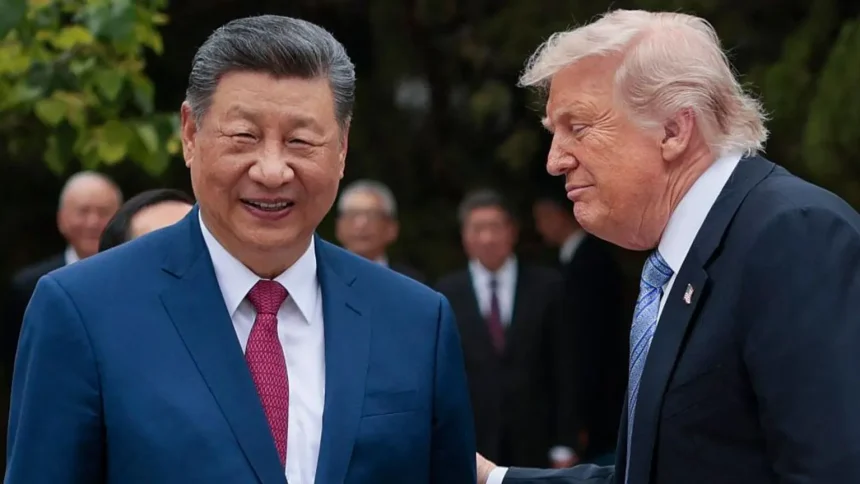
After three days of intensive dialogue, private dinners, and a high-profile “CEO stroll” through the Great Hall of the People, the most anticipated diplomatic event of 2026 has concluded. President Donald Trump and President Xi Jinping have characterized their talks as “very successful,” “constructive,” and “deeply meaningful.”
Yet, for the markets and global observers waiting for a “Big Deal”—a massive tariff reduction or a definitive security pact—the summit ended with a familiar silence. No formal treaties were signed, and no joint communiqués detailing economic breakthroughs were released. Instead, the world was given a “Four-Pillar Framework” for strategic stability.
Is this a genuine reset of the world’s most important relationship, or simply a well-choreographed pause in an inevitable rivalry?
The CEO Delegation: Business as Diplomacy
One of the most striking images of the summit was not the two presidents alone, but the massive American business delegation that followed President Trump to Beijing. Accompanied by tech titans like Elon Musk and Jensen Huang, Trump made it clear that “the business of America is business.”
The presence of these leaders suggests that while official government “deals” were absent, private-sector negotiations were likely the summit’s true engine. Discussions reportedly centered on:
Market Access: Pushing for fewer restrictions on American AI and EV firms operating within the Chinese mainland.
Supply Chain Resilience: Finding a middle ground on the export of rare-earth minerals and high-end semiconductor chips.
Agricultural Pledges: Encouraging China to return to record-breaking purchases of U.S. soybeans and corn to support the American “Heartland.”
The Four Pillars: A New Ruleset for 2026
In lieu of a trade treaty, the leaders announced a new “Strategic Stability Framework.” This is designed to act as a “floor” to prevent the relationship from spiraling into open conflict.
Cooperation as the Mainstay: Focusing on climate tech, global health, and narcotics.
Moderate Competition: Acknowledging that the two nations are rivals in the tech and space sectors but agreeing to “compete fairly.”
Manageable Differences: Establishing a high-level “hotline” for military and economic disputes.
Enduring Peace: A long-term commitment to avoiding kinetic (armed) conflict.
The Taiwan “Red Line”
Despite the warm optics, the issue of Taiwan remains the “third rail” of the relationship. During a private session, President Xi was reportedly blunt, issuing a stern warning that mishandling the Taiwan issue would be the “first red line” that cannot be crossed.
Xi’s warning comes as a $14 billion U.S. arms deal for Taiwan remains on the table. While Trump was non-committal during the press conference, the lack of a deal on this front suggests that the two sides are still far apart on the security architecture of the Indo-Pacific.