
Health ministries in Paris and Washington have provided sobering updates on the status of their citizens following Sunday’s military-led evacuations.
France (Critical Condition): Health Minister Stéphanie Rist confirmed that a French woman, one of five repatriated to Paris, tested positive after her condition worsened significantly overnight. She is currently being treated in a high-security infectious disease unit. United States (Nebraska Isolation):
Out of 17 Americans flown to a federal facility in Nebraska, one has tested positive but remains asymptomatic. A second American is reporting mild symptoms. Both are being monitored by the same team that handled Ebola and early COVID-19 cases. Total Toll:
The outbreak has already claimed three lives (a Dutch couple and a German woman), with at least six confirmed cases globally as of this morning. The Andes Strain: Why the Concern?While most hantaviruses are only spread via rodent droppings, the World Health Organization (WHO) confirmed on May 6 that this outbreak involves the Andes virus. The Difference:
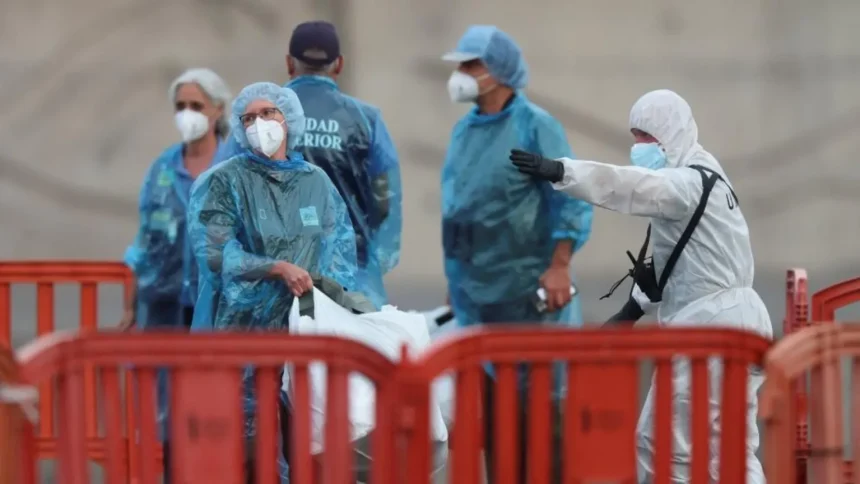
The Andes strain is the only known hantavirus capable of human-to-human transmission. While rare and typically requiring prolonged close contact, this factor has forced Spanish authorities and the CDC to treat the evacuation with “Level 3” emergency protocols, involving full-body protective suits and respirators.
The Evacuation: A Race Against TimeThe port of Granadilla in Tenerife has become a makeshift international medical hub.Global Tracing: Passengers from over 23 nationalities are being filtered into country-specific repatriation flights. The 42-Day Rule:
Because the incubation period for Hantavirus Pulmonary Syndrome (HPS) can be as long as eight weeks, all returning passengers are subject to a 42-day mandatory monitoring period. Repatriation Flights: Australia is expected to send the final evacuation flight today to retrieve its citizens and those from New Zealand and various Asian countries. Risk Assessment:
“Not Another COVID”Despite the dramatic images of biohazard suits at the port, WHO Director-General Tedros Adhanom Ghebreyesus has urged calm. Public Risk: Rated as “Very Low” for the general population. Transmission: Unlike respiratory viruses like the flu, the Andes virus does not stay suspended in the air for long distances; transmission usually requires shared living spaces or intimate contact.